Loading history...
Everything around us is made of matter, and all matter is composed of elements and compounds. Understanding these fundamental building blocks helps us comprehend how the world works at the atomic level.
What Are Elements?
Definition and Characteristics
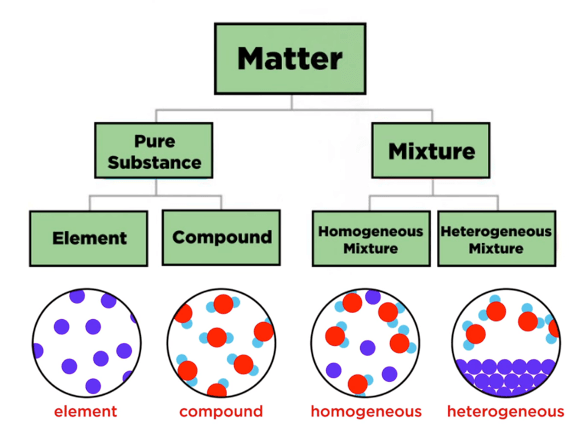
An element is a pure substance that consists of only one type of atom and cannot be broken down into simpler substances by chemical means.
Key Properties of Elements
- Pure substances: Made of only one type of atom
- Cannot be decomposed: Cannot be broken down chemically
- Unique identity: Each element has a unique atomic number
- Characteristic properties: Each has distinct physical and chemical properties
- Building blocks: Combine to form all other substances
How Many Elements Exist?
Currently, 118 elements are officially recognized:
- Natural elements: 92 elements occur naturally (hydrogen to uranium)
- Synthetic elements: 26 elements created in laboratories
- Superheavy elements: Very unstable, exist for fractions of seconds
- Future discoveries: Scientists continue searching for new elements
Element Names and Symbols
Each element has:
- Name: Hydrogen, Carbon, Oxygen, Gold, etc.
- Symbol: H, C, O, Au (from Latin names sometimes)
- Atomic number: Number of protons (H=1, C=6, O=8, Au=79)
Examples of common elements
- Oxygen (O): Essential for breathing and combustion
- Nitrogen (N): Makes up 78% of air
- Helium (He): Used in balloons, inert gas
- Hydrogen (H): Lightest element, fuel potential
- Iron (Fe): Steel structures, cars, tools
- Aluminum (Al): Foil, cans, aircraft
- Copper (Cu): Wires, pipes, coins
- Gold (Au): Jewelry, electronics
- Silver (Ag): Jewelry, mirrors, antibacterial
- Carbon (C): Diamond, graphite, organic compounds
- Sulfur (S): Matches, fertilizers, proteins
- Chlorine (Cl): Water disinfection, table salt
- Silicon (Si): Computer chips, glass
What Are Compounds?
Definition and Formation
A compound is a pure substance formed when two or more different elements are chemically bonded together in fixed proportions.
Key Properties of Compounds
- Multiple elements: Always contain two or more different elements
- Chemical bonds: Elements held together by chemical forces
- Fixed composition: Always same ratio of elements
- New properties: Properties completely different from constituent elements
- Can be decomposed: Broken down into elements by chemical methods
Chemical Formulas
Compounds are represented by chemical formulas that show:
- Element symbols: Which elements are present
- Subscripts: How many atoms of each element
- Proportions: Fixed ratios between elements
Reading Chemical Formulas
- H₂O: 2 hydrogen atoms + 1 oxygen atom = water
- CO₂: 1 carbon atom + 2 oxygen atoms = carbon dioxide
- NaCl: 1 sodium atom + 1 chlorine atom = table salt
- C₆H₁₂O₆: 6 carbon + 12 hydrogen + 6 oxygen = glucose
Example: How water (H₂O) forms and behaves
- Hydrogen (H): Explosive, flammable gas
- Oxygen (O): Colorless gas that supports combustion
- 2H₂ + O₂ → 2H₂O (explosive reaction!)
- Energy released as heat and light
- New chemical bonds form between H and O atoms
- Properties: Liquid at room temperature, not flammable
- Completely different: Nothing like hydrogen or oxygen gas
- Fixed composition: Always 2:1 ratio of H to O
- Essential for life: Supports biological processes
- Electrolysis: Electric current splits H₂O → H₂ + O₂
- Energy required: Must add energy to break bonds
- Products: Get back original hydrogen and oxygen gases
Comparing Elements and Compounds
| Property | Elements | Compounds |
|---|---|---|
| Composition | One type of atom only | Two or more different elements |
| Separation | Cannot be broken down chemically | Can be decomposed into elements |
| Properties | Characteristic of that element | Different from constituent elements |
| Examples | H, O, C, Fe, Au | H₂O, CO₂, NaCl, C₆H₁₂O₆ |
| Formation | Cannot be created from simpler substances | Formed by chemical combination of elements |
| Symbols/Formulas | Single element symbol (e.g., O) | Chemical formula (e.g., H₂O) |
The Periodic Table: Organizing Elements
Organization Principles
The periodic table organizes all elements by:
- Atomic number: Number of protons (increases left to right)
- Electron configuration: How electrons are arranged
- Properties: Similar elements grouped together
- Periodic trends: Properties that change predictably
Major Categories
- Metals: Good conductors, shiny, malleable (left side)
- Non-metals: Poor conductors, brittle when solid (right side)
- Metalloids: Properties between metals and non-metals (diagonal line)
- Noble gases: Very stable, rarely react (far right column)
Chemical Bonding: How Compounds Form
Why Do Elements Bond?
Elements bond to achieve more stable electron configurations:
- Energy minimization: Lower energy states are more stable
- Electron sharing or transfer: Achieve stable electron arrangements
- Noble gas configuration: Most stable arrangement
Types of Chemical Bonds
1. Ionic Bonds
- Formation: Metal gives electrons to non-metal
- Result: Charged ions attract each other
- Example: Na⁺Cl⁻ (sodium chloride/table salt)
- Properties: High melting points, conduct when dissolved
2. Covalent Bonds
- Formation: Non-metals share electrons
- Result: Shared electron pairs hold atoms together
- Example: H₂O (water), CO₂ (carbon dioxide)
- Properties: Various melting points, usually don't conduct
3. Metallic Bonds
- Formation: Metal atoms share electrons in "electron sea"
- Result: Flexible bonding allows movement
- Properties: Conductive, malleable, ductile
Properties: Elements vs. Compounds
How Properties Change
When elements form compounds, their properties change dramatically:
Example: Sodium and Chlorine forming Salt
- Soft, silvery metal
- Highly reactive with water (explosive)
- Must be stored under oil
- Would burn your skin on contact
- Greenish-yellow poisonous gas
- Used as chemical weapon in WWI
- Irritates eyes and respiratory system
- Deadly in high concentrations
- White crystalline solid
- Essential for human life
- Safe to eat (in moderation)
- Dissolves easily in water
- Used for food flavoring and preservation
Why Properties Change
- New electron arrangements: Bonding changes electron distribution
- Different forces: New intermolecular forces between molecules
- Crystal structure: Atoms arrange in new patterns
- Energy states: More stable configurations formed
Synthesis and Decomposition
Synthesis Reactions (Making Compounds)
Elements combine to form compounds:
Examples of Synthesis
- 2H₂ + O₂ → 2H₂O: Hydrogen and oxygen make water
- C + O₂ → CO₂: Carbon burns to make carbon dioxide
- 2Na + Cl₂ → 2NaCl: Sodium and chlorine make salt
- N₂ + 3H₂ → 2NH₃: Nitrogen and hydrogen make ammonia
Decomposition Reactions (Breaking Down Compounds)
Compounds can be broken down into their elements:
Methods of Decomposition
- Electrolysis: Electric current breaks bonds
- Thermal decomposition: Heat breaks down compounds
- Chemical reactions: Other chemicals cause breakdown
Examples of Decomposition
- 2H₂O → 2H₂ + O₂: Water splits into hydrogen and oxygen
- 2HgO → 2Hg + O₂: Mercury oxide decomposes when heated
- CaCO₃ → CaO + CO₂: Limestone breaks down with heat
Molecules: The Building Blocks of Compounds
What Are Molecules?
A molecule is the smallest unit of a compound that retains all the chemical properties of that compound.
Molecular Structure
- Atoms bonded together: Two or more atoms connected
- Specific arrangement: 3D structure determines properties
- Molecular formula: Shows types and numbers of atoms
- Structural formula: Shows how atoms are connected
Types of Molecules
Simple Molecules
- H₂O: Water (bent shape)
- CO₂: Carbon dioxide (linear)
- NH₃: Ammonia (pyramidal)
- CH₄: Methane (tetrahedral)
Complex Molecules
- C₆H₁₂O₆: Glucose (sugar)
- C₈H₁₈: Octane (gasoline component)
- DNA: Millions of atoms in precise arrangement
- Proteins: Complex 3D structures with specific functions
Everyday Applications
Elements in Daily Life
Technology and Electronics
- Silicon (Si): Computer chips, solar panels
- Copper (Cu): Electrical wiring
- Gold (Au): Circuit boards, connectors
- Lithium (Li): Batteries
Construction and Infrastructure
- Iron (Fe): Steel for buildings, bridges
- Aluminum (Al): Aircraft, window frames
- Titanium (Ti): Aerospace applications
- Carbon (C): Carbon fiber materials
Compounds in Daily Life
Food and Nutrition
- H₂O: Water - essential for life
- C₆H₁₂O₆: Glucose - blood sugar
- NaCl: Table salt - flavor and preservation
- CaCO₃: Calcium carbonate - antacids, supplements
Household Products
- NH₃: Ammonia - cleaning products
- NaHCO₃: Baking soda - cooking, cleaning
- C₂H₆O: Ethanol - rubbing alcohol
- H₂O₂: Hydrogen peroxide - disinfectant
Environmental Importance
Atmospheric Compounds
- CO₂: Carbon dioxide - greenhouse gas, photosynthesis
- O₃: Ozone - protective layer, air pollutant
- H₂O: Water vapor - weather, climate
- CH₄: Methane - greenhouse gas
Earth's Composition
- SiO₂: Silicon dioxide - sand, quartz
- CaCO₃: Calcium carbonate - limestone, marble
- Fe₂O₃: Iron oxide - rust, red soil
- Al₂O₃: Aluminum oxide - sapphires, rubies
Industrial Applications
Chemical Manufacturing
- NH₃: Ammonia production for fertilizers
- H₂SO₄: Sulfuric acid - most produced chemical
- NaOH: Sodium hydroxide - soap, paper production
- CaO: Lime - cement, steel production
Energy Production
- H₂: Hydrogen - future fuel
- CH₄: Natural gas - heating, electricity
- C₈H₁₈: Octane - gasoline
- U: Uranium - nuclear power
Future Developments
New Elements
- Superheavy elements: Elements 119, 120, and beyond
- Island of stability: Predicted stable superheavy elements
- Applications: Unknown properties might have unique uses
Advanced Compounds
- Nanomaterials: Compounds with atomic-scale structures
- Smart materials: Compounds that respond to environment
- Green chemistry: Environmentally friendly compounds
- Pharmaceuticals: Designer molecules for medicine
Key Takeaways
- Elements are pure substances with only one type of atom (118 known)
- Compounds are pure substances with two or more elements chemically bonded
- Properties of compounds are completely different from their constituent elements
- Chemical formulas show the types and numbers of atoms in compounds
- Elements combine through ionic, covalent, or metallic bonding
- Compounds can be decomposed into elements by chemical methods
- Molecules are the smallest units of compounds that retain their properties
- Elements and compounds are essential for life, technology, and industry
- Understanding elements and compounds helps explain the behavior of all matter