Chemical elements are the building blocks of matter. Their behavior is explained by atomic structure, periodic classification, and chemical bonding.
1. Atomic Models
Scientific models of the atom changed as new experiments appeared.
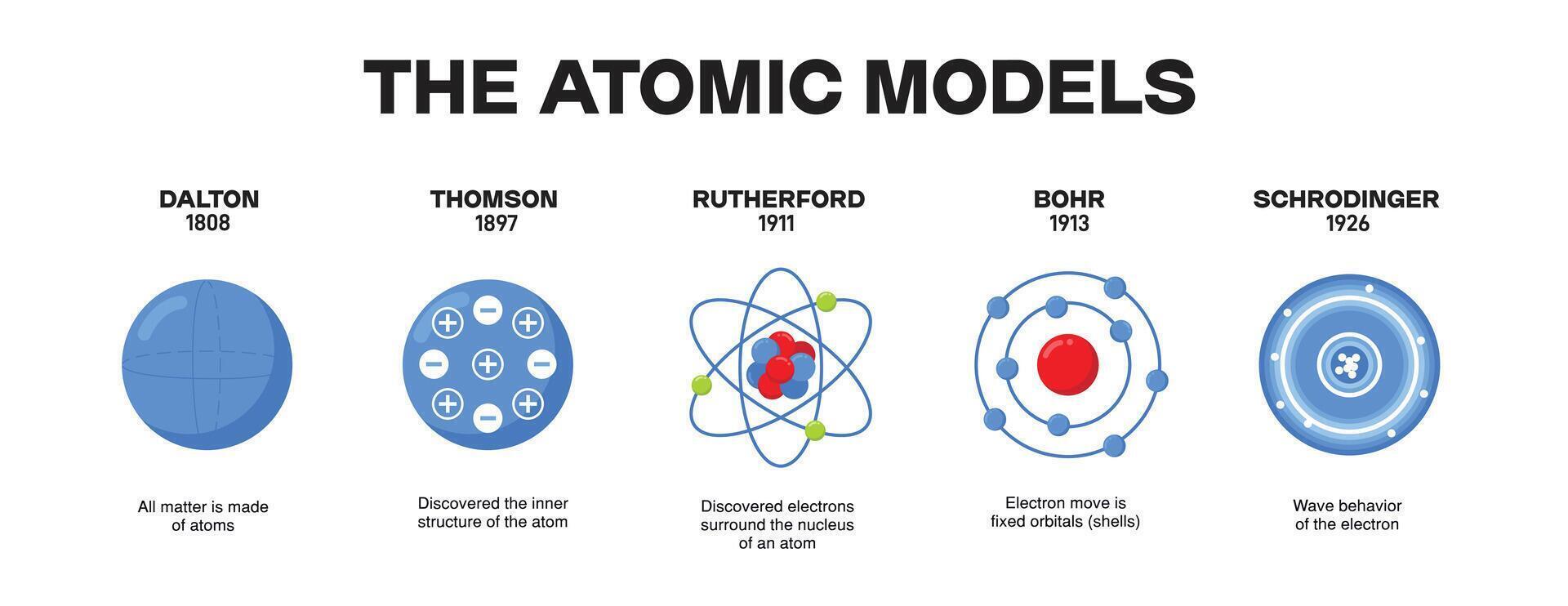
Dalton model
- Matter is made of indivisible atoms.
- Atoms of the same element are equal in mass and properties.
- Atoms combine in fixed whole-number ratios.
Thomson model
- Proposed after the electron was discovered.
- Atom is a positive sphere with embedded electrons.
Rutherford model
- Based on the gold foil experiment.
- Atom is mostly empty space.
- A small positive nucleus contains most of the mass.
Bohr model
- Electrons orbit in fixed energy levels.
- Electrons jump levels by absorbing or emitting energy.
Quantum model
- Electrons are described by probability regions (orbitals).
- Exact position and momentum cannot be known at the same time.
2. Subatomic Particles
| Particle | Symbol | Charge | Relative mass (u) | Mass (kg) | Location |
|---|---|---|---|---|---|
| Proton | $p^+$ | $+1$ | $1$ | $1.673 \times 10^{-27}$ | Nucleus |
| Neutron | $n^0$ | $0$ | $1$ | $1.675 \times 10^{-27}$ | Nucleus |
| Electron | $e^-$ | $-1$ | $\approx 0$ | $9.109 \times 10^{-31}$ | Electron cloud |
3. Atomic Number and Mass Number
| Symbol | Meaning |
|---|---|
| $Z$ | Number of protons (atomic number) |
| $A$ | Protons + neutrons (mass number) |
| $n$ | Number of neutrons |
| $e$ | Number of electrons |
| $q$ | Ion charge |
Useful relations:
$$
A = Z + n
$$
$$
n = A - Z
$$
$$
q = p - e
$$
The element identity is defined by $Z$.
Isotopes
Isotopes have the same $Z$ but different $A$.
$$
^{12}\mathrm{C}\ (99\%), \quad ^{13}\mathrm{C}\ (1\%), \quad ^{14}\mathrm{C}\ (trace)
$$
4. Main Periodic Groups
- Metals: usually lose electrons, good conductors, often shiny and malleable.
- Nonmetals: usually gain electrons, poor conductors, variable state.
- Metalloids: intermediate properties, often semiconductors.
- Noble gases: very low reactivity.
5. Comparison of Element Types
| Property | Metals | Metalloids | Nonmetals |
|---|---|---|---|
| Electrical conductivity | High | Medium (semiconductor) | Low |
| Thermal conductivity | High | Medium | Low |
| Malleability | Usually yes | No | No |
| Ductility | Usually yes | No | No |
| State at $20^\circ\mathrm{C}$ | Mostly solid | Solid | Solid/liquid/gas |
| Electron tendency | Lose electrons | Gain or lose | Gain electrons |
| Examples | Fe, Cu, Al | Si, Ge | O, N, Cl |
6. Chemical Bonding
Atoms bond to become more stable.
Ionic bond
- Between metal and nonmetal.
- Electrons are transferred.
- Forms ions in a crystal lattice.
- Example: $\mathrm{NaCl}$.
Covalent bond
- Between nonmetals.
- Electrons are shared.
- Forms molecules or covalent networks.
- Examples: $\mathrm{H_2O}$, $\mathrm{CO_2}$, $\mathrm{CH_4}$.
Metallic bond
- Between metal atoms.
- Delocalized electrons form an electron sea.
- Explains conductivity and malleability.
7. Comparison of Bond Types
| Property | Ionic | Covalent | Metallic |
|---|---|---|---|
| Elements involved | Metal + nonmetal | Nonmetal + nonmetal | Metals |
| Electron behavior | Transfer | Sharing | Delocalization |
| Typical structure | Ionic lattice | Molecules or networks | Metal lattice |
| Melting point | Usually high | Low-medium (very high in networks) | Usually high |
| Electrical conductivity | High when molten/dissolved | Low | High |
| Typical state | Solid | Solid/liquid/gas | Solid (except Hg) |
| Examples | $\mathrm{NaCl}$, $\mathrm{MgO}$ | $\mathrm{H_2O}$, $\mathrm{CO_2}$ | Fe, Cu, Al |
8. Element vs Compound
- Element: one type of atom (examples: $\mathrm{O_2}$, Fe, Au).
- Compound: two or more elements in fixed proportion (examples: $\mathrm{H_2O}$, $\mathrm{NaCl}$, $\mathrm{CO_2}$).
9. Physical vs Chemical Changes
Physical changes
- No new substance forms.
- Only state, shape, or size changes.
- Example: melting ice.
Chemical changes
- New substances form by bond breaking/forming.
- Typical signs: color change, gas, precipitate, heat or light.