Chemical Kinetics
Chemical kinetics is the study of the speed or rate at which chemical reactions occur. While some reactions (like explosions or fireworks) happen incredibly fast in fractions of a second, others (like the rusting of an old car or the formation of fossil fuels) can take years or millions of years.
Understanding what controls this speed is crucial in everything from preventing our food from spoiling to designing safe industrial processes and understanding how our bodies preserve life.
Two Ways to Understand Reaction Speeds
Scientists use two main theories to explain how reactions happen, looking at them from different perspectives: one at the level of individual particles, and one at the level of overall system energy.
1. Collision Theory (Microscopic View)
The collision theory looks at a chemical reaction from a microscopic perspective, focusing on the random movements and collisions of individual particular molecules.
For a reaction to occur, the reacting particles (atoms, ions, or molecules) must come into contact. Collision theory dictates three strict rules: 1. Collision: Particles must collide with one another. 2. Energy: They must collide with enough kinetic energy to break their existing chemical bonds. If they collide gently, they simply bounce off each other intact. 3. Orientation: They must collide in the correct orientation so that the proper atoms align and new bonds can form.
Anything that increases the frequency of successful, high-energy collisions will increase the reaction rate.
2. Transition State Theory (Macroscopic View)
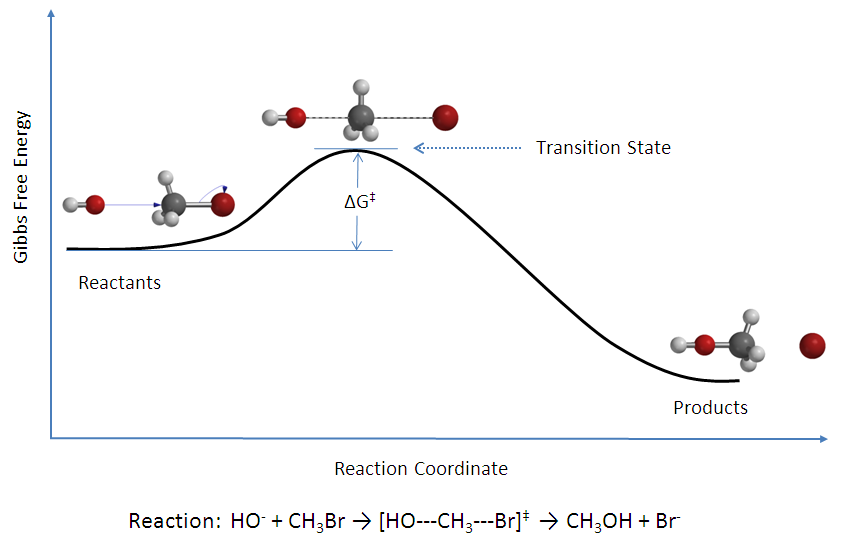
The transition state theory takes a macroscopic perspective, tracking the overall energy changes of the entire system (the "energy mountain" diagram) as reactants transform into products.
Instead of focusing on individual bouncing molecules, this theory focuses on the energy barrier that the whole reaction mixture must overcome.
- When molecules collide with sufficient energy, they momentarily form an unstable, highly energetic arrangement of atoms called the transition state (or activated complex).
- This transition state exists at the very peak of the energy diagram. The energy required to reach this peak is called the Activation Energy ($E_a$).
- From this peak, the atoms can cleanly reorganize and drop down into the stable state of the final products.
Factors Affecting Reaction Rates
Based on collision theory, we can alter the speed of a reaction by changing certain conditions. Here are the five main factors:
1. State of Matter
The physical state (solid, liquid, gas) of the reactants greatly affects how easily they can mix and collide.
- Gases react fastest because their particles are moving freely and randomly, allowing for very rapid mixing and extremely frequent collisions.
- Liquids react faster than solids because their molecules are held closely together but can still move around. That makes them to usually react faster than gases.
- Solids react the slowest because their particles are tightly fixed in place, and the reaction can only happen exactly where surfaces touch.
- Solutions are the most common way to perform reactions in a lab because liquids allow reactants to mix thoroughly and collide frequently while keeping them contained and controlled.
can react very quickly because the solid particles are fully dispersed and surrounded by the liquid, maximizing contact.
2. Contact Surface Area (for Solids)
When a solid reacts with a liquid or a gas, the reaction can only happen at the boundary where they touch (the surface).
- Larger surface area = more particles exposed = more collisions = faster reaction
- Smaller surface area = fewer particles exposed = fewer collisions = slower reaction
Example: Steel wool burns
Normal steel does not burn under a regular lighter, but steel wool does because it consists of very fine threads with a huge surface area exposed to the oxygen in the air.
3. Concentration (and Pressure for Gases)
Concentration refers to how many reactant particles are crowded into a particular space.
- Higher concentration = particles are closer together = more frequent collisions = faster reaction
- Lower concentration = particles are spread out = fewer collisions = slower reaction
Example: Acid on metal
A piece of zinc metal will bubble and dissolve much faster in highly concentrated acid than in diluted (watered-down) acid.
For gases, increasing the pressure forces the gas particles closer together into a smaller volume. This is effectively the same as increasing concentration and results in a faster reaction rate.
4. Temperature
Temperature is a measure of the average kinetic energy (movement energy) of particles.
- Higher temperature = molecules move much faster = more frequent AND more energetic collisions = faster reaction
- Lower temperature = molecules move slower = fewer and less energetic collisions = slower reaction
Example: Baking a cake
If you put cake batter in the oven, it bakes beautifully due to the high temperature speeding up the chemical reactions. If you leave the batter on the kitchen counter at room temperature, it won't turn into a cake!
Generally, raising the temperature by just 10°C can often double the speed of many reactions!
5. Catalysts and Enzymes

A catalyst is a special substance that speeds up a reaction without being permanently consumed or altered itself in the process.
- It works by finding an alternative pathway for the reaction that has a lower activation energy. Because the energy barrier is smaller, more particles now have enough energy to react when they collide.
- You get the catalyst back completely unchanged at the end of the reaction.
Enzymes are a special and extremely important type of catalyst: biological catalysts. Our bodies run thousands of chemical reactions every second. At our normal body temperature of 37°C, these reactions would naturally be far too slow to keep us alive. Enzymes (proteins) speed up these essential biological reactions, like digesting food or copying DNA, by millions of times!
- Like inorganic catalysts, enzymes are extremely specific. For example, the enzyme lactase only breaks down lactose (milk sugar).
Example: Elephant Toothpaste
Hydrogen peroxide naturally breaks down into water and oxygen very slowly over months. However, adding a catalyst like potassium iodide causes the reaction to finish in literal seconds, creating a massive foam eruption!
Summary Table: How Variables Affect Reaction Speed
| Variable | Change | Effect on Speed | Reason (Collision Theory) | Example |
|---|---|---|---|---|
| Temperature | Increase | Speeds up | Particles move faster and hit harder | Cooking food faster at high heat, Fridge slows rotting |
| Concentration | Increase | Speeds up | More particles crowded together, more hits | Strong cleaning acid works immediately |
| Pressure (Gases) | Increase | Speeds up | Pushes gas particles closer together | Industrial ammonia production |
| Surface Area | Increase (crush into powder) | Speeds up | More area exposed for hits | Powdered sugar dissolves faster than sugar cubes |
| Catalyst / Enzyme | Add | Speeds up | Lowers the energy needed to react | Enzymes digesting food in saliva |