1. Indicate the name of each part of the graph: (7 points)
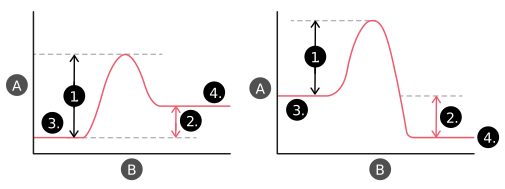
a ) Label A

b ) Label B

c ) Label 1

d ) Label 2

e ) Label 3

f ) Label 4

g ) Which graph represents an endothermic reaction?(left or right)

2. Quicklime has been one of the most used reactions in human history used to build houses and obtention of basic reactant:<br>CaCO₃ (s) + Heat → CaO (s) + CO₂ (g): (10 points)

a ) Is this reaction endothermic or exothermic?

b ) In an energy diagram for an endothermic reaction, are the products positioned HIGHER or LOWER than the reactants?

c ) Is ΔE(or ΔH) >0(+) or <0(-)

d ) When a catalyst is added, does the activation energy: increase or decrease?

e ) When comparing catalyzed vs uncatalyzed pathways on the same diagram, which has the lower peak?

f ) Do catalysts change the starting energy level (reactants) or ending energy level (products)?

3. In a laboratory experiment, the synthesis of magnesium oxide shows that 2.4 g of magnesium reacts completely with 1.6 g of oxygen to produce 4.0 g of MgO. (4 points)

a ) How many grams of magnesium would be required to produce 125 g of MgO?

b ) Which chemical law did you use?

4. If we react a stoichiometric mixture of 73 g of hydrogen chloride (HCl) with 80 g of sodium hydroxide (NaOH), we produce 117 g of sodium chloride (NaCl) and a certain mass of water (H₂O). (4 points)

a ) Calculate the mass of water produced

b ) Which chemical law did you use?

5. Indicate if the following changes would make a reaction FASTER(f) or SLOWER(s): (6 points)

a ) Grinding a solid reactant into fine powder makes the reaction:

b ) Decreasing temperature makes the reaction:

c ) Adding a platinum (Pt) catalyst makes the reaction:

d ) Increasing container volume for gaseous reactants makes the reaction:

e ) Increasing reactant concentration in solution makes the reaction:

f ) Removing an enzyme from a biological process makes the reaction:

6. Balance: P (s) + O₂ (g) → P₂O₅ (s). Use the smallest integer numbers. (2 points)

a ) Coefficient for P:

b ) Coefficient for O₂:

c ) Coefficient for P₂O₅:

7. Balance: KClO₃ (s) → KCl (s) + O₂ (g). Use the smallest integer numbers. (2 points)

a ) Coefficient for KClO₃:

b ) Coefficient for KCl:

c ) Coefficient for O₂:

8. Balance: Al (s) + H₂SO₄ (aq) → Al₂(SO₄)₃ (aq) + H₂ (g). Use the smallest integer numbers. (2 points)

a ) Coefficient for Al:

b ) Coefficient for H₂SO₄:

c ) Coefficient for Al₂(SO₄)₃:

d ) Coefficient for H₂:

9. Balance: C₃H₈ (g) + O₂ (g) → CO₂ (g) + H₂O (g). Use the smallest integer numbers. (2 points)

a ) Coefficient for C₃H₈:

b ) Coefficient for O₂:

c ) Coefficient for CO₂:

d ) Coefficient for H₂O:

10. Balance: Al (s) + O₂ (g) → Al₂O₃ (s). Use the smallest integer numbers. (2 points)

a ) Coefficient for Al:

b ) Coefficient for O₂:

c ) Coefficient for Al₂O₃:

11. Balance: C₂H₆ (g) + O₂ (g) → CO₂ (g) + H₂O (g). Use the smallest integer numbers. (2 points)

a ) Coefficient for C₂H₆:

b ) Coefficient for O₂:

c ) Coefficient for CO₂:

d ) Coefficient for H₂O:

12. Oxygen gas can be generated by heating silver oxide (Ag₂O), which decomposes into solid silver (Ag) and oxygen gas (O₂). Given 464 g of Ag₂O. Data: Ag = 108 g/mol, O = 16 g/mol. (6 points)

a ) Adjust the reaction and give the coefficient for Ag₂O, using the smallest integer numbers.

b ) Coefficient for Ag

c ) Coefficient for O₂

d ) Calculate the mass of Ag produced.

e ) Calculate the mass of O₂ produced.

13. Calculating Moles, Molecules, and Atoms (H₂O): (3 points)

a ) Calculate moles of H₂O in 90 g. (M(H₂O) = 18 g/mol). Round to 1 decimal place

b ) How many molecules of H₂O are present? (Use Avogadro's number: 6.022 × 10²³). Use scientific notation (e.g., 3.011e24)

c ) How many Hydrogen (H) and Oxygen (O) atoms total are present? Each H₂O has 2 H + 1 O = 3 atoms. (Use scientific notation)