Stoichiometry
Stoichiometry is the study of the quantitative relationships between reactants and products in chemical reactions.
Balanced Chemical Equations
A balanced equation shows the correct ratio of reactants to products, following the Law of Conservation of Mass (atoms are neither created nor destroyed).
Example:
Meaning:
- 2 molecules of hydrogen react with 1 molecule of oxygen
- to produce 2 molecules of water
- The mole ratio is 2 : 1 : 2
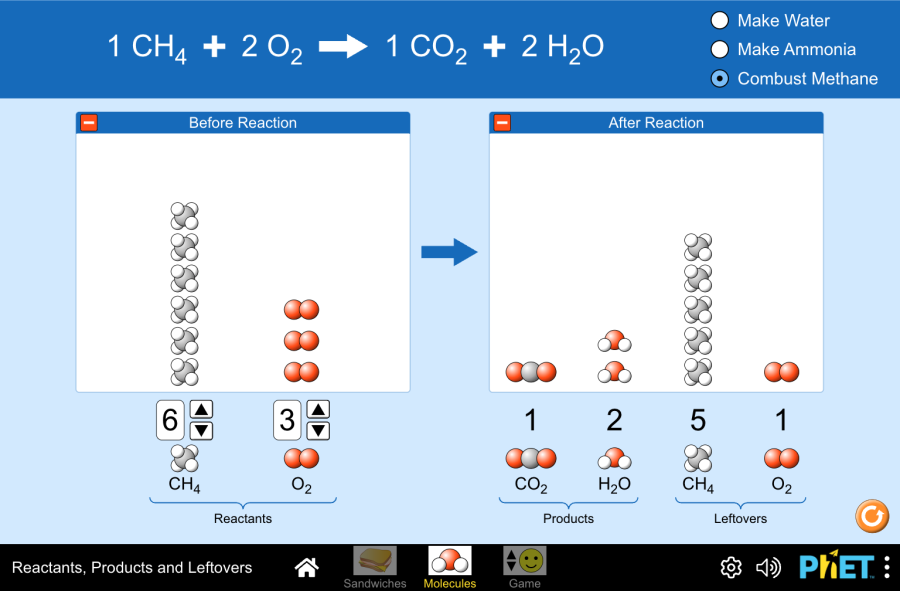
How to Balance Equations
There are different methods to balance chemical equations:
1. Inspection Method (Trial and Error)
1. Count atoms of each element on each side of the equation. 2. Adjust coefficients (never change the subscripts!) to balance the atoms. 3. Start with the most complex molecule. 4. Leave pure elements (like $O_2$ or $H_2$) for last.
Example: Balance the equation: C + O₂ → CO₂
Left side: 1 C, 2 O.
Right side: 1 C, 2 O.
Answer: C + O₂ → CO₂ (Already balanced!)
Example: Balance: Fe + O₂ → Fe₂O₃
We start with O. Left has 2, right has 3. The common multiple is 6.
Place a 3 in front of O₂ and a 2 in front of Fe₂O₃.
Now we have 4 Fe on the right, so put a 4 in front of Fe on the left.
Answer: 4Fe + 3O₂ → 2Fe₂O₃
2. The Oxygen Fraction Trick (for Combustion)
When balancing combustion reactions with $O_2$, you can use a fraction $n/2$ to get an odd number of oxygen atoms, and then multiply the entire equation by 2 to get whole numbers.
Example: Balance the combustion of Butane: C₄H₁₀ + O₂ → CO₂ + H₂O
Balance C first: C₄H₁₀ + O₂ → 4CO₂ + H₂O
Balance H next: C₄H₁₀ + O₂ → 4CO₂ + 5H₂O
Count Oxygen on the right: (4 × 2) + 5 = 13 O atoms.
To get 13 O atoms on the left, use the fraction 13/2 for O₂:
C₄H₁₀ + 13/2 O₂ → 4CO₂ + 5H₂O
Multiply everything by 2 to remove the fraction:
Answer: 2C₄H₁₀ + 13O₂ → 8CO₂ + 10H₂O
3. Algebraic Method
For complex equations, use variables for coefficients and solve the system of linear equations.
1. Assign a letter (a, b, c, etc.) to each coefficient. 2. Write an algebraic equation for each element based on the conservation of atoms. 3. Assign a value of 1 (or 2) to the variable that appears most often. 4. Solve for the other variables. 5. If there are fractions, multiply all variables by the lowest common denominator to get integers.
Example: Balance: a NH₃ + b O₂ → c NO + d H₂O
Equations for each element:
- N: a = c
- H: 3a = 2d
- O: 2b = c + d
Let's set a = 2 (to make 3a an even number, avoiding fractions for d).
If a = 2, then c = 2.
From H: 3(2) = 2d → 6 = 2d → d = 3.
From O: 2b = c + d → 2b = 2 + 3 → 2b = 5 → b = 5/2.
Our coefficients are: a=2, b=5/2, c=2, d=3.
Multiply all by 2 to remove the fraction: a=4, b=5, c=4, d=6.
Answer: 4NH₃ + 5O₂ → 4NO + 6H₂O
Stoichiometric Calculations
Use the balanced equation to convert between quantities of reactants and products. The coefficients tell us the exact mole ratio.
General steps: 1. Write the balanced equation. 2. Convert the given amount into moles (if it isn't already). 3. Use the mole ratio to find the moles of the desired substance. 4. Convert those moles into the desired units (grams, particles).
Example: Given the reaction: 2H₂ + O₂ → 2H₂O. How many grams of water are produced from 4 mol of hydrogen?
We are given 4 mol of H₂. We want mass of H₂O.
The mole ratio from the equation is 2 mol H₂ : 2 mol H₂O (which is 1:1).
Calculate moles of H₂O: 4 mol H₂ × (2 mol H₂O / 2 mol H₂) = 4 mol H₂O.
Convert moles of H₂O to mass: 4 mol × 18 g/mol = 72 g.
Answer: 72 g
Example: Calculate the mass of CO₂ produced when burning 16 g of CH₄ in excess oxygen: CH₄ + 2O₂ → CO₂ + 2H₂O
Molar mass CH₄ = 12 + 4(1) = 16 g/mol.
Molar mass CO₂ = 12 + 2(16) = 44 g/mol.
Convert mass of CH₄ to moles: 16 g ÷ 16 g/mol = 1 mol CH₄.
Use mole ratio: 1 mol CH₄ produces 1 mol CO₂.
Convert moles of CO₂ to mass: 1 mol CO₂ × 44 g/mol = 44 g.
Answer: 44 g
Example: How many moles of Aluminum are needed to react with 3 moles of HCl? 2Al + 6HCl → 2AlCl₃ + 3H₂
We are given 3 mol of HCl. We want moles of Al.
The mole ratio is 2 mol Al : 6 mol HCl.
Calculate: 3 mol HCl × (2 mol Al / 6 mol HCl) = 1 mol Al.
Answer: 1 mol Al
Limiting Reactant
Often, reactants are not mixed in exact stoichiometric ratios. Since all reactants are needed for a reaction to occur, the one that runs out first—the limiting reactant—determines how much product can be formed. It is completely consumed while the others remain in excess.