What is a Wave?
A wave is a way of moving energy from one place to another without moving matter. Think of it like a ripple in a pond: the water moves up and down, but the energy travels across the surface.
Types of Waves
1. Mechanical Waves: These need a material (like air, water, or ground) to travel through. Example: Sound. 2. Electromagnetic Waves: These can travel through empty space (vacuum). Example: Light.
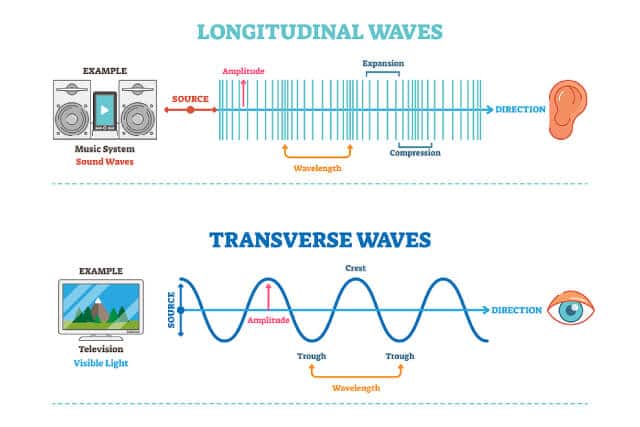
Wave Direction: Longitudinal and Transverse
Waves can also be grouped by the way the particles of the medium move compared with the direction of the wave.
- Longitudinal waves: the particles move parallel to the direction the wave travels. Sound is a good example.
- Transverse waves: the particles move perpendicular to the direction the wave travels. Light is an example of a transverse wave.
- In some cases, like water surface waves, the motion can be a mix of both.
The Three Main Properties
Every wave is defined by these three simple characteristics:
1. Wavelength
The distance between two consecutive peaks. It represents the "width" of a single wave cycle.
- Longer waves carry less energy.
- Shorter waves carry more energy.
2. Frequency
This is the "speed" of the vibration—how many waves pass a point each second.
- High frequency means waves are packed tightly together (Short wavelength).
- Low frequency means waves are spread far apart (Long wavelength).
3. Amplitude
The height or "strength" of the wave. It tells us how much energy is being carried.
- Large amplitude = Stronger energy (Loud sound or Bright light).
- Small amplitude = Weaker energy (Soft sound or Dim light).
Sound: Vibrations we Hear
Sound is a mechanical wave created by vibrations. It travels faster through solids than through air.
- Pitch (High vs Low): This depends on Frequency. High frequency sounds are "squeaky" (like a bird), while low frequency sounds are "deep" (like a drum).
- Loudness: This depends on Amplitude. The higher the wave, the louder the sound.
Light: Energy we See
Light is an electromagnetic wave. It is the fastest thing in the universe.
- Color: Different colors are actually different Frequencies. Red has the lowest frequency (longest wavelength), while Violet has the highest (shortest wavelength).
- Brightness: This depends on Amplitude. More amplitude means a brighter light source.
The Invisible Spectrum
Light is just a small part of a huge family called the Electromagnetic Spectrum.
- Low frequency: Radio waves, Microwaves, Infrared (heat).
- Visible: The colors we see.
- High frequency: Ultraviolet (UV), X-rays, Gamma rays.
How Waves Behave
When waves hit obstacles or change materials, they do interesting things:
- Reflection: Bouncing off a surface (like a mirror or an echo).
- Refraction: Bending when entering a new material (like a straw looking broken in water).
- Diffraction: Spreading out around corners or through gaps.
Summary
| Property | In Sound | In Light |
|---|---|---|
| Frequency | Pitch (Bass/Treble) | Color |
| Amplitude | Loudness (Volume) | Brightness |
| Wavelength | Size of the vibration | Type of radiation |
Exercise 1 Find the wave speed
A wave has a wavelength of 4 m and a frequency of 5 Hz. What is its speed?
Given: λ = 4 m, f = 5 Hz
Formula: v = λ · f
Solution:
$v = 4 \text{ m} \times 5 \text{ Hz} = 20 \text{ m/s}$
The wave travels at 20 m/s.
Exercise 2 Find the wavelength
Sound travels at 340 m/s in air. If its frequency is 680 Hz, what is its wavelength?
Given: v = 340 m/s, f = 680 Hz
Formula: λ = v / f
Solution:
$\lambda = \frac{340 \text{ m/s}}{680 \text{ Hz}} = 0.5 \text{ m}$
The wavelength is 0.5 m.
Exercise 3 Find the period
A wave has a frequency of 0.25 Hz. What is its period?
Given: f = 0.25 Hz
Formula: T = 1 / f
Solution:
$T = \frac{1}{0.25 \text{ Hz}} = 4 \text{ s}$
The period is 4 s — the wave completes one full cycle every 4 seconds.
Exercise 4 Find the frequency
A pendulum swings back and forth with a period of 0.5 s. What is its frequency?
Given: T = 0.5 s
Formula: f = 1 / T
Solution:
$f = \frac{1}{0.5 \text{ s}} = 2 \text{ Hz}$
The frequency is 2 Hz — it completes 2 full cycles per second.
Exercise 5 Find the speed using period and wavelength
A water wave has a wavelength of 3 m and a period of 1.5 s. What is its speed?
Given: λ = 3 m, T = 1.5 s
Formula: v = λ / T
Solution:
$v = \frac{3 \text{ m}}{1.5 \text{ s}} = 2 \text{ m/s}$
The wave moves at 2 m/s.
Exercise 6 Find the period from speed and wavelength
Light travels at 3 × 10⁸ m/s. A radio wave has a wavelength of 150 m. What is its period?
Given: v = 3 × 10⁸ m/s, λ = 150 m
Steps: First find the frequency, then the period.
Solution:
$f = \frac{v}{\lambda} = \frac{3 \times 10^8 \text{ m/s}}{150 \text{ m}} = 2 \times 10^6 \text{ Hz}$
$T = \frac{1}{f} = \frac{1}{2 \times 10^6 \text{ Hz}} = 5 \times 10^{-7} \text{ s} = 0.5 \text{ μs}$
The period is 0.5 microseconds.