What is Heat?
Heat is the transfer of thermal energy between objects due to a difference in temperature. It always flows from hot to cold until thermal equilibrium (equal temperature) is reached.
1. Heat Transfer Mechanisms
Heat can move in three ways:
| Mechanism | Main Idea | Medium |
|---|---|---|
| Conduction | Direct contact | Solids (mostly) |
| Convection | Fluid movement | Liquids and Gases |
| Radiation | Waves | Vacuum and Transparent media |
A. Conduction
Transfer through direct contact where particles vibrate and pass energy to neighbors. Metals are great conductors because they have "free electrons" that move energy quickly.
Curiosities & Examples of Conduction
- Thermal Conductivity (k): A value that measures how fast heat moves. Copper (k=400) is much faster than wood (k=0.1).
- The "Cold" Spoon: A metal spoon feels colder than a wooden one even if both are at 20°C because the metal conducts heat away from your hand faster.
- Double Glazing: Windows use a layer of air between two glass panes. Since air is a terrible conductor, it keeps the house warm.
B. Convection
Transfer through the actual movement of a fluid (liquid or gas). Hot fluid expands, becomes less dense, and rises, while cold fluid sinks. This creates convection currents.
Curiosities & Examples of Convection
- Sea Breezes: During the day, land heats up faster than the sea. Hot air over land rises, and cool air from the sea blows in to replace it.
- Radiators: They are usually placed at the bottom of a room so the hot air can rise and circulate naturally.
- Boiling Water: You can see "currents" in a pot as the hot water from the bottom moves up.
C. Radiation
Transfer via electromagnetic waves (mostly infrared). It is the only way heat can travel through a vacuum (like space).
Curiosities & Examples of Radiation
- The Sun: We feel the Sun's heat even though there is 150 million km of empty space between us.
- Colors: Black surfaces absorb radiation (and get hot), while white/shiny surfaces reflect it.
- Night Vision: Thermal cameras "see" the infrared radiation emitted by warm bodies like humans or animals.
2. Specific Heat
To calculate the amount of energy (heat) required to change the temperature of an object, we use the following formula:
Where:
- Eh = Heat energy transferred (Joules, J)
- m = Mass of the substance (kg)
- ks = Specific heat capacity (J/kg·°C)
- ΔT = Temperature change ($T_{final} - T_{initial}$)
Specific Heat Capacity (ks)
This is the energy required to raise the temperature of 1 kg of a substance by 1°C.
Specific Heat Capacity of common substances
| Material | ks (J/kg·°C) | Why it matters |
|---|---|---|
| Water | 4 200 | Very high! Oceans stay cool in summer. |
| Ice | 2 100 | Half that of liquid water. |
| Aluminum | 900 | Good for pans. |
| Glass | 840 | Average insulator. |
| Iron | 450 | Heats up quickly. |
| Lead | 130 | Heats up extremely fast. |
Worked Examples
Example 1: How much heat is needed to warm 2 kg of water from 20°C to 50°C? (ks = 4,200 J/kg·°C)
1. Identify data: m = 2 kg, $k_s = 4,200$, ΔT = 50 - 20 = 30°C
2. Apply formula: $E_q = 2 \times 4,200 \times 30$
3. Result: $E_q = 252,000 \text{ J}$
Example 2: An iron bar of 0.5 kg cools down from 100°C to 20°C. How much heat does it release? (ks = 450 J/kg·°C)
1. Identify data: m = 0.5 kg, $k_s = 450$, ΔT = 20 - 100 = -80°C
2. Apply formula: $E_q = 0.5 \times 450 \times (-80)$
3. Result: $E_q = -18,000 \text{ J}$ (Negative means energy is lost/released)
3. Latent heat (phase Changes)
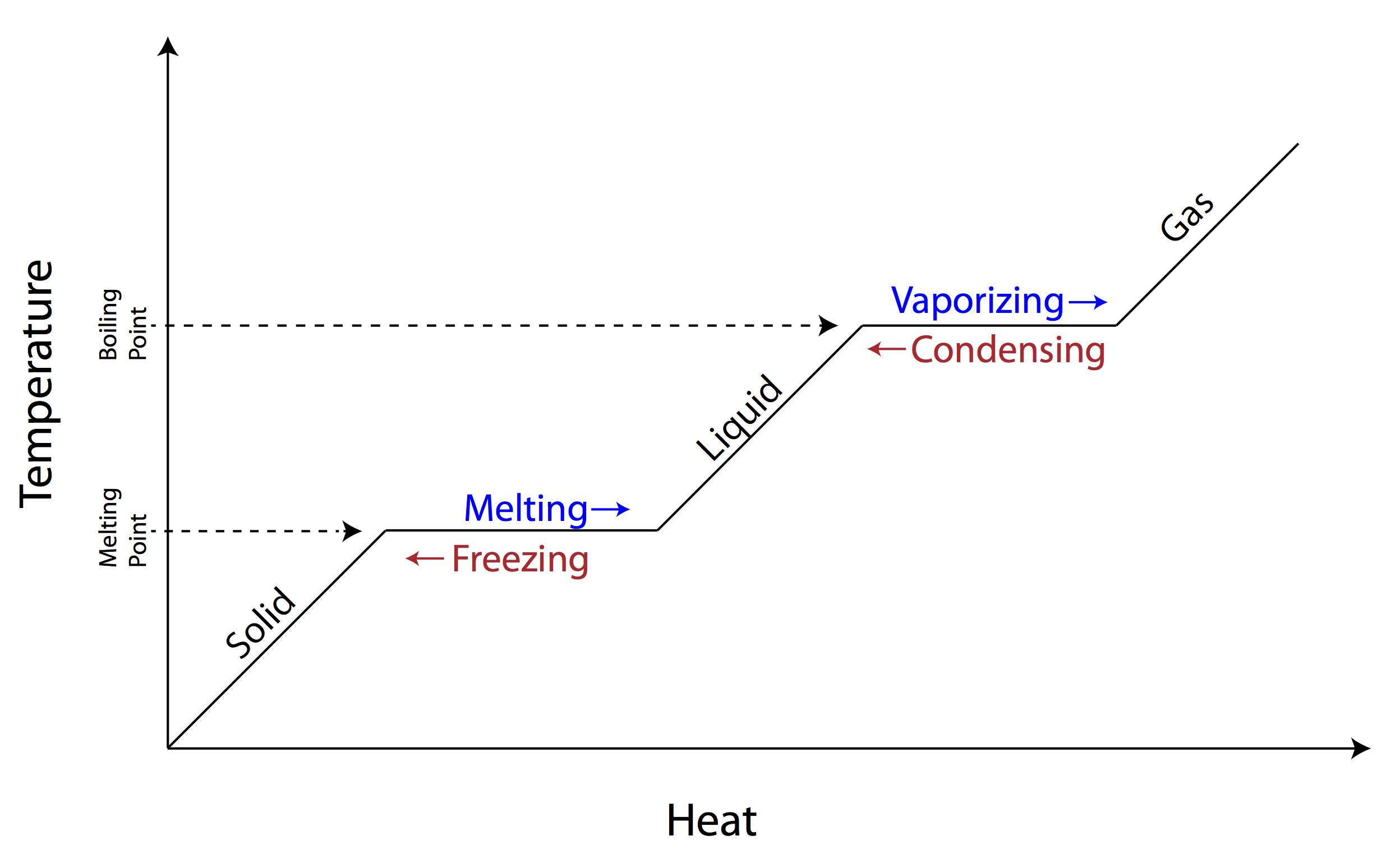
When a substance changes state (like ice melting), it absorbs heat without changing its temperature.
- kl = Latent heat (J/kg). For water fusion (melting), $k_l = 334,000 \text{ J/kg}$.
Example 3: How much heat is needed to melt 2 kg of ice at 0°C? (kl = 334,000 J/kg)
1. Identify data: m = 2 kg, $k_l = 334,000$
2. Apply formula: $E_q = 2 \times 334,000$
3. Result: $E_q = 668,000 \text{ J}$
4. Combined Calculations (Multi-step)
When a substance must be warmed to its melting point before it can melt, or warmed further after melting, we sum the heat from each step.
Example 4: Calculate the heat needed to turn 1 kg of ice at -10°C into water at 0°C (ks ice = 2,100 J/kg·°C, kl = 334,000 J/kg).
1. Step 1: Warm the ice to 0°C
$E_{q1} = 1 \text{ kg} \times 2,100 \times (0 - (-10)) = 21,000 \text{ J}$
2. Step 2: Melt the ice at 0°C
$E_{q2} = 1 \text{ kg} \times 334,000 = 334,000 \text{ J}$
3. Total: $E_{q1} + E_{q2} = 21,000 + 334,000 = \textbf{355,000 J}$
Example 5: – How much heat is needed to turn 0.2 kg of ice at -10°C into water at 50°C?
1. Step 1: Warm ice to 0°C: $E_{q1} = 0.2 \times 2,100 \times 10 = 4,200 \text{ J}$
2. Step 2: Melt ice at 0°C: $E_{q2} = 0.2 \times 334,000 = 66,800 \text{ J}$
3. Step 3: Warm water to 50°C: $E_{q3} = 0.2 \times 4,200 \times 50 = 42,000 \text{ J}$
4. Total: $4,200 + 66,800 + 42,000 = \textbf{113,000 J}$