Temperature
Definition of Temperature
Temperature is a measure of the average kinetic energy (Ek) of particles (atoms and molecules) in a substance.
Important distinction:
- Temperature: Measure of average molecular motion (scalar)
- Heat: Energy transferred between objects due to temperature difference
- Thermal energy: Total kinetic energy of all particles
Temperature vs. Heat
Key Differences
| Temperature | Heat |
|---|---|
| Measure of molecular Ek | Energy transfer |
| Scalar quantity | Energy (scalar) |
| Measured in °C, °F, K | Measured in Joules (J) |
| Property of matter | Process between objects |
| Same in all reference frames | Directional (hot to cold) |
Temperature determines direction of heat flow:
- Heat flows from higher temperature to lower temperature
- At equilibrium: temperatures equal, heat flow stops
Laws of Thermodynamics
| Law | Statement | Example |
|---|---|---|
| 0th Law | Systems tend to reach thermal equilibrium | Two bodies at different temperatures in contact end up at the same temperature |
| 1st Law | Energy is conserved — it can be transformed but never created or destroyed | Chemical energy in fuel becomes heat and mechanical energy in an engine |
| 2nd Law | Energy tends to spread out and become less useful (entropy increases) | Heat flows naturally from hot to cold, never the reverse on its own |
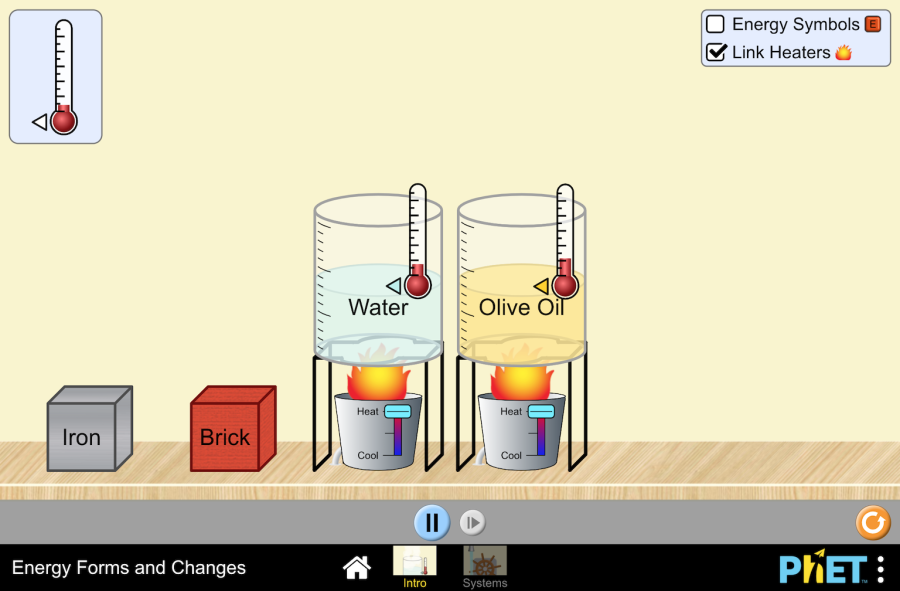
Effects of Temperature
1. Thermal Expansion
Most substances expand when heated and contract when cooled.
Linear Expansion
$$
\Delta L = \alpha L_0 \Delta T
$$
Where:
- ΔL = change in length
- α = linear expansion coefficient
- L₀ = original length
- ΔT = temperature change
Example: A 2-meter aluminum rod (α = 23 × 10⁻⁶ /°C) is heated from 10°C to 300°C. Calculate the change in length.
$$
\Delta L = 23 \times 10^{-6} \times 2 \times (300 - 10) = 23 \times 10^{-6} \times 2 \times 290 = 0.01334 \text{ m} = 13.34 \text{ mm}
$$
2. Changes in Physical Properties
As temperature increases:
| Property | Effect | Example |
|---|---|---|
| Density | Decreases | Ice floats on water |
| Solubility | Usually increases | More salt dissolves in hot water |
| Electrical resistance | Increases (metals) | Light bulb filament resistance |
| Reactivity | Increases | Chemical reactions faster |
Temperature and Motion
Absolute Zero
Temperature at which all molecular motion theoretically stops
- 0 K = -273.15°C = -459.67°F
- Cannot be reached (laws of thermodynamics)
- Reference point for absolute temperature scale
Types of molecular movement
- Translation: Movement from one place to another
- Rotation: Rotation around an axis
- Vibration: Oscillation around an equilibrium position