Changes of Matter
Phase changes (or state changes) are physical processes where matter transitions from one state to another. These changes involve energy transfer but do not change the chemical composition of the substance.
Types of Phase Changes
1. Melting (Fusion)
Solid → Liquid
- Process: Heat energy breaks intermolecular forces, allowing particles to move more freely
- Temperature: Occurs at the melting point (specific for each substance)
- Energy: Requires energy input (endothermic process)
- Examples: Ice melting to water, chocolate melting
2. Freezing (Solidification)
Liquid → Solid
- Process: Removal of heat energy allows intermolecular forces to lock particles in place
- Temperature: Occurs at the freezing point (same as melting point)
- Energy: Releases energy (exothermic process)
- Examples: Water freezing to ice, molten metal solidifying
3. Evaporation/Vaporization
Liquid → Gas
Two Types:
- Evaporation: Occurs at any temperature from the surface only
- Boiling: Occurs at boiling point throughout the entire liquid
Characteristics:
- Process: High-energy particles escape from liquid surface
- Energy: Requires energy input (endothermic process)
- Cooling effect: Remaining liquid becomes cooler
- Examples: Water evaporating from a puddle, steam from boiling water
Why Water Evaporates at Room Temperature
The Maxwell-Boltzmann distribution explains why liquids can evaporate even below their boiling point:

Key Principles:
- Energy Distribution: Not all particles in a liquid have the same kinetic energy
- High-Energy Tail: Some particles have much higher energy than the average
- Escape Energy: Particles with energy above the threshold can escape from the liquid surface
- Temperature Effect: Higher temperatures shift the curve right, increasing the fraction of high-energy particles
Evaporation Process:
1. Particles at the liquid surface with sufficient energy break free from intermolecular forces 2. These high-energy particles escape as vapor 3. The remaining liquid loses its most energetic particles 4. Average energy (temperature) of remaining liquid decreases - cooling effect
Factors Affecting Evaporation Rate
Air Humidity
Humidity plays a crucial role in evaporation rate:
- Low Humidity: Air can hold more water vapor, faster evaporation
- High Humidity: Air is nearly saturated with water vapor, slower evaporation
- Dynamic Equilibrium: At 100% humidity, evaporation rate equals condensation rate
- Vapor Pressure: Higher humidity increases the partial pressure of water vapor in air
Other Factors:
- Temperature: Higher temperature increases the number of high-energy particles
- Surface Area: More surface area allows more particles to escape
- Air Movement: Wind removes water vapor, maintaining concentration gradient
- Atmospheric Pressure: Lower pressure makes it easier for particles to escape
Example: Why clothes dry faster on a sunny, windy day
Optimal drying conditions combine multiple factors:
- Sunlight (Heat): Increases temperature, shifting Maxwell-Boltzmann distribution to higher energies
- Wind: Removes water vapor from around the fabric, maintaining low local humidity
- Low Humidity: Dry air can absorb more water vapor
- Large Surface Area: Clothes spread out expose maximum surface to air
Result: Maximum evaporation rate due to favorable conditions for high-energy water molecules to escape.
4. Condensation
Gas → Liquid
- Process: Gas particles lose energy and come together to form liquid
- Energy: Releases energy (exothermic process)
- Temperature: Often occurs when gas is cooled
- Examples: Water vapor condensing on cold glass, dew formation
5. Sublimation
Solid → Gas (directly, skipping liquid phase)
- Process: Solid particles gain enough energy to become gas without melting
- Energy: Requires significant energy input (endothermic process)
- Conditions: Often occurs at low pressure or specific temperatures
- Examples: Dry ice (solid CO₂), mothballs, freeze-drying
6. Deposition
Gas → Solid (directly, skipping liquid phase)
- Process: Gas particles lose energy and arrange directly into solid structure
- Energy: Releases energy (exothermic process)
- Examples: Frost formation, snowflake formation in clouds
Example: Phase changes in daily life
Scenario: Making ice cubes and observing phase changes
Phase changes involved:
1. Filling ice tray: Liquid water at room temperature
2. Placing in freezer: Water cools down (temperature decreases)
3. Freezing point reached: Temperature stays constant at 0°C
4. Freezing occurs: Liquid → Solid (exothermic, releases energy)
5. Ice formation: Solid ice at freezer temperature
6. Removing ice: Ice begins to warm up
7. Melting begins: Solid → Liquid at 0°C (endothermic, absorbs energy)
Key observation: Temperature remains constant during freezing and melting!
Energy and Phase Changes
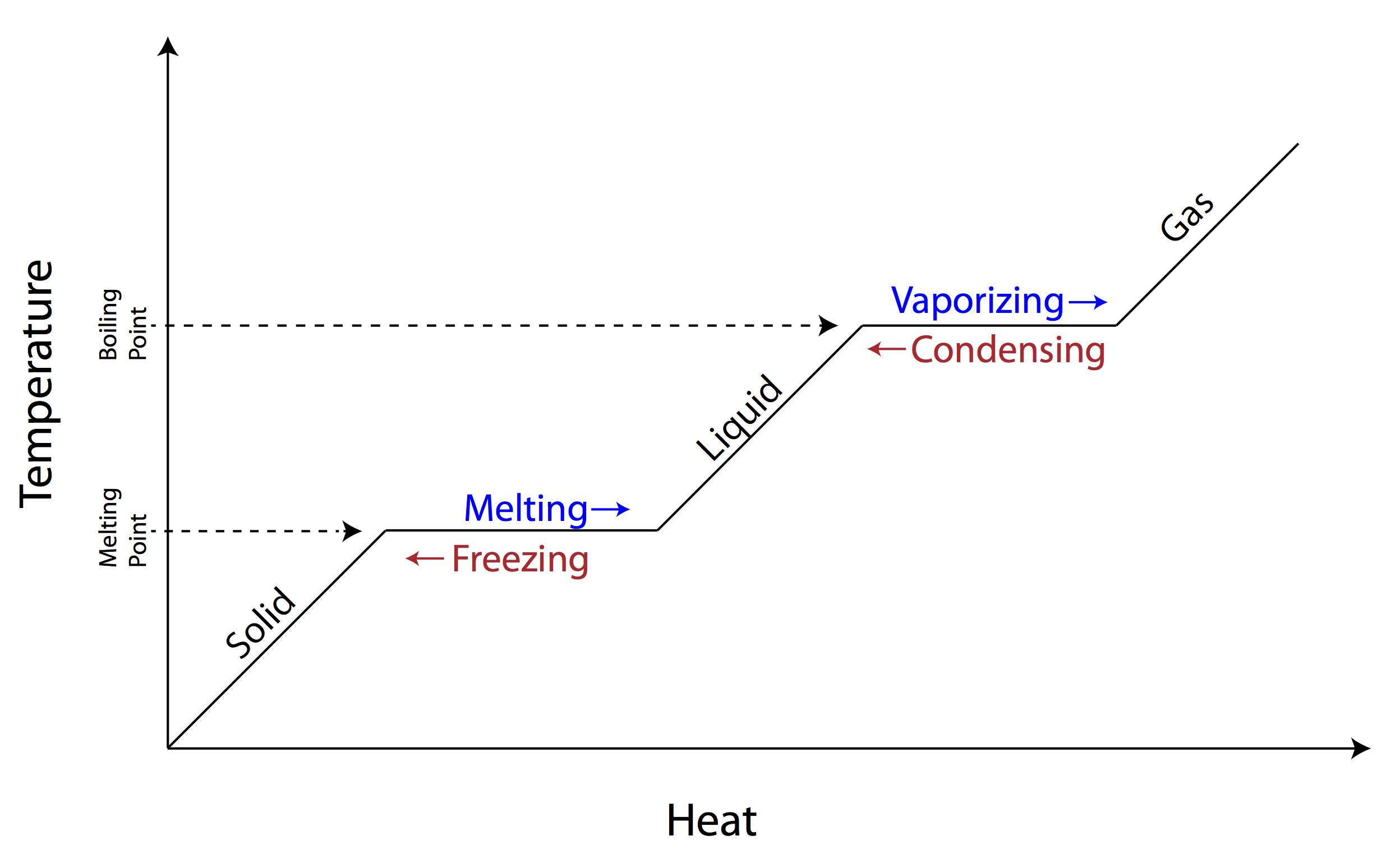
Heating and Cooling Curves
These graphs show how temperature changes over time during heating or cooling:
Key Features:
- Sloped sections: Temperature change within a single state
- Flat sections: Phase changes occurring at constant temperature
- Heat of fusion: Energy needed for melting/freezing
- Heat of vaporization: Energy needed for vaporization/condensation
Latent Heat
The energy required for phase changes without temperature change:
- Heat of fusion (Lf): Energy per unit mass for melting/freezing
- Heat of vaporization (Lv): Energy per unit mass for vaporization/condensation
Example: Energy calculation for melting ice
Problem: How much energy is needed to melt 100 g of ice at 0°C?
Given: Heat of fusion for water = 334 J/g
Solution:
Result: 33,400 J (or 33.4 kJ) of energy is needed to melt the ice.
Factors Affecting Phase Changes
Temperature
- Higher temperature favors less ordered states
- Each substance has characteristic transition temperatures
- Temperature remains constant during phase change
Pressure
- Higher pressure favors more ordered states
- Affects boiling and melting points
- Lower pressure allows boiling at lower temperatures
Surface Area and Air Movement
- Larger surface area increases evaporation rate
- Wind or air circulation increases evaporation
- Removes vapor particles from liquid surface
Real-world Applications
Cooling Systems
- Refrigerators: Use evaporation and condensation cycles
- Air conditioners: Evaporative cooling
- Sweating: Body cooling through evaporation
Industrial Processes
- Distillation: Separating liquids by different boiling points
- Freeze-drying: Food preservation using sublimation
- Metal casting: Melting and solidification
Weather Phenomena
- Rain cycle: Evaporation, condensation, precipitation
- Snow formation: Deposition of water vapor
- Fog: Condensation of water vapor in air