Important Formulas
Density formula: $d = \frac{m}{V}$
Combined gas law: $ \frac{P_1 \cdot V_1}{T_1} = \frac{P_2 \cdot V_2}{T_2} = constant$
Density formula: $d = \frac{m}{V}$
Combined gas law: $ \frac{P_1 \cdot V_1}{T_1} = \frac{P_2 \cdot V_2}{T_2} = constant$
1. Complete the following table about the kinetic theory of matter: (4 points)
2. Gold has a density of 19 300 kg/m³. Solve the following: (4 points)
3. A refrigerator cools its contents by allowing a pressurized refrigerant to expand and thereby cool down. Suppose the gas expands from 2.0 atm and 20°C with a volume of 1.0 L, to a pressure of 1.0 atm and a volume of 1.8 L. Assuming the gas behaves ideally, <strong>calculate its final temperature in °C</strong>: (4 points)
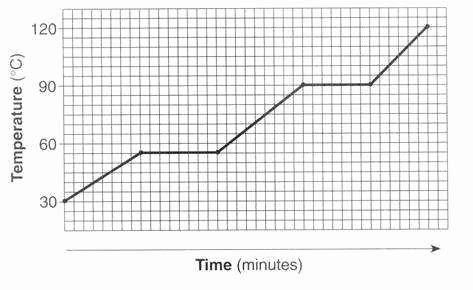
4. Given the heating curve of this substance, identify the following parts: (5 points)
5. Even on a cool day, wet clothes can dry when left outdoors. Which statement best explains why this happens? (1 point)
6. During condensation, energy is: (1 points)
7. If the pressure on a gas is reduced to half, and temperature stays constant, what happens to the volume? (1 points)
8. When a gas is heated in a rigid container (constant volume), what happens to the pressure? (1 points)
9. Given a phase diagram of carbon dioxide (CO₂) showing regions for solid, liquid, and gas phases: (2 points)
